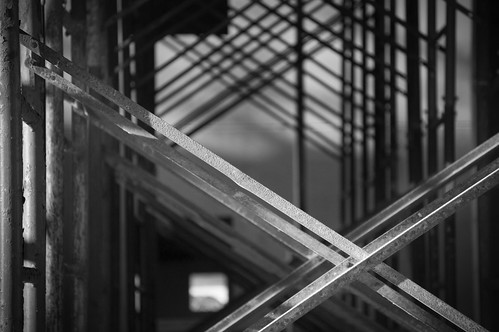
Finally got around to taking another pic for the GT Photo Club. This week's theme was "Industry." I took a picture of some scaffolding at a construction site close to the house. I had to set up the tripod (love the new tripod) on a small strip of land right next to an Atlanta highway. Exciting photographic danger.
Wednesday, March 05, 2008

Friday, February 22, 2008
MSE Magic
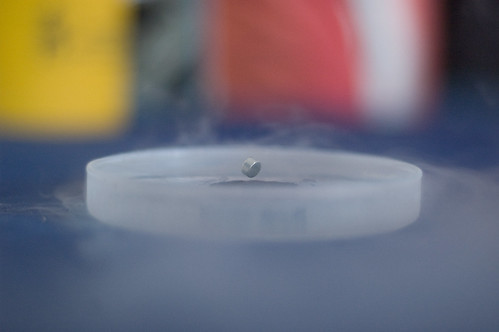
I recently had the opportunity to photograph the Materials Science and Engineering booth at Georgia Tech's Engineers Week fair. MSE was demonstrating several interesting properties of materials, including the low thermal conductivity of a space shuttle heat-shield tile, a methanol powered fuel cell, and the extreme expansion of nitrogen as it boils. In the photograph shown here, a superconductor is cooled with liquid nitrogen to below its critical temperature (the temperature below which it superconducts). When that happens, it generates a magnetic field stronger than gravity. Put a magnet on top and what do you get? Levitation.
Tuesday, January 22, 2008
Flickr and the Library of Congress

Flickr, the photosharing site, has teamed up with the Library of Congress, the keepers of thousands of historic photos, in order to put the power of Web 2.0 and user-generated content to good use. Flickr will host over three thousand of the Library's images (the program is still in the pilot stage) and invite Flickr members to tag or comment on photos such as the one above. In this way, the photos become more public for people like us, and the Library can harness the collective knowledge of the public to enhance their metadata for the images, improving the quality of the collection. It always interests me when I see things like this: new technologies enabling ordinary people to collectively have a greater impact than ever before.
Here are the Library's thoughts before and 24 hours after the pilot program started.
Here are Flickr's thoughts before and 24 hours after the program started.
Here's the Flickr site: The Commons.
Thursday, January 17, 2008
It's Snowing!
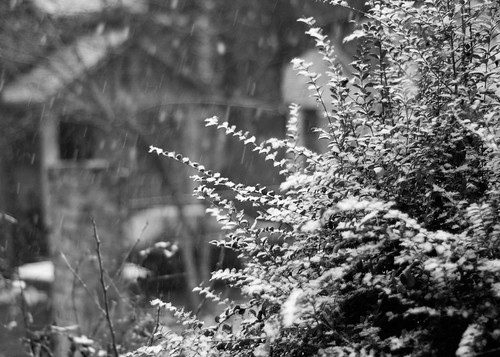
Atlanta snow--who would have guessed? It didn't stick though, unfortunately. One of my roommates did make a lovely little snowman outside our door.
Monday, January 14, 2008
Broken
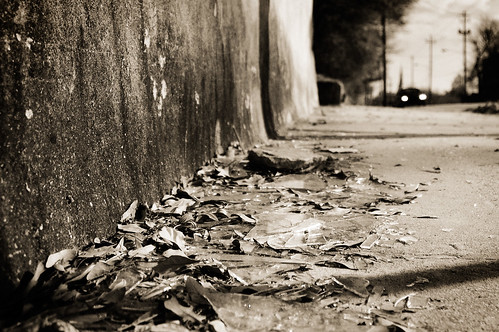
This photo was taken for an assignment for the GT Photo Club. The theme for the week was "Broken," so we were supposed to take a picture that somehow embodied that theme. I had been walking past this broken glass on my way to and from class several times a day all week, and finally found the time to go out and shoot it. The next day, someone had cleaned up the glass and it was gone. Goes to show you shouldn't wait to shoot something you're interested in--it's all only temporary.
The picture was conceived, pre-visualized, shot, and processed within about an hour and half. This is a markedly different approach than my other pictures, some of which I've been working on for months. I think there are some virtues in this fast-paced approach, at least some of the time. A raw or half-processed photograph sitting on a hard drive is useless--something has to get produced, even if it is a bit rough around the edges.
I just discovered the GT Photo Club a few weeks ago, and joined it for exactly this kind of thing. If I let it, it will give me a sense of obligation to pick up my camera and take pictures. Knowing me, I will quickly let my schoolwork overtake me, and not make time for photography, which should probably be as high a priority as coursework, if only for my own sanity. It looks like school already gets in the way, though; I found out this morning that I will have to miss the next two Photo Club meetings due to some extra stuff I have to do for a certain class. C'est la vie.
Wednesday, November 14, 2007
iPhotoshop
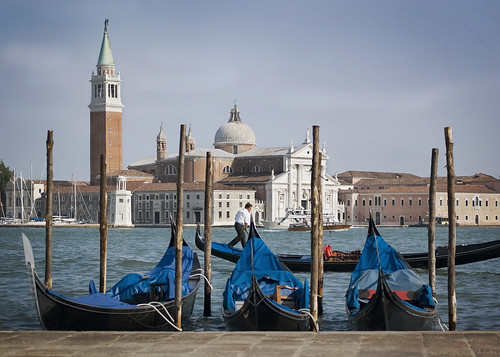
Well, the transition is complete.
I've moved all my photographic "stuff" (and most everything else, too) from my Linux-based laptop to my new iMac. After reading The DAM Book, I was able to implement a system of tagging, cataloging, and archiving that will grow with my photograph collection; this mess I've had to go through of re-tagging and organizing all my photos should never happen again. The system is also set up for painless and frequent backups, which is something I've been meaning to implement for a while.
Fancy folder organization, exhaustive tagging, and expensive software don't mean a thing without photographic vision. Last week April and I saw an exhibition of the work of Harry Callahan in Atlanta. His work was remarkable, showing his mastery over line, shape, and tone. April pointed out two adjacent images obviously taken within minutes of each other. One, she noted, had a harsh, cold feel to it; light and dark had been pushed to such extremes that most detail was lost--all that was left was the white shape of his wife's body against a completely black background. The other was much more sensuous. Light seemed to wrap around her body, revealing nuanced detail in her skin. I told her that the difference in the photographs was not made by the camera--likely the two images were made with the exact same exposure. Rather, the vision was fulfilled in the darkroom, with the use of contrast filters and other light adjustment techniques such as dodging and burning.
I was recently asked by someone how the digital age and Adobe Photoshop was changing photography, and whether photography has become "more about Photoshop" and less about accomplishing things in-camera. I think such a question stems from two main factors: first, that yes, digital imaging has changed the photographic landscape in significant ways. Emails containing "photoshopped" images of bizarre or surreal scenes spread like wildfire through cyberspace, clouding people's idea of what Photoshop actually does for us. It's not just about composites, people. And when it is used for composites, it doesn't have to be about distorting reality. In my last post I showed a composite photograph that makes no attempt to be anything else. Photoshop allowed me to present those two images as a set, much like I would present them if they were printed and hanging on a wall. Though I could have done this in a traditional darkroom, it would not have been nearly as quick or precise.
The second main factor contributing to such questions is a lack of understanding of the kind of power the darkroom gave film photographers over their images. Photography has never stopped when the shutter closes; the real magic happens in the printing process. The darkroom, whether chemical or digital, gives us control over tonal values; essentially we decide whether to make parts of an image lighter or darker. That really is the essence of all darkroom work. The trick is knowing what needs its value changed, and then what that value should be. That decision is unchanged from chemical to digital darkroom. Where the digital darkroom excels is in giving the photographer real-time feedback on what his choices are doing to the image, with every step being completely editable and reversible. In a chemical darkroom, such steps are done on a "latent" image--which means you are staring at a white piece of paper until you actually develop it. If you don't like one of your steps, you have to do it all over again, which can be quite frustrating. So a digital darkroom like Photoshop gives us all the control film photographers have, but perhaps more nuanced, and also removes much of the frustration and uncertainty of working with a latent image, freeing us to work more creatively--not to mention it keeps us all from smelling like fixer all day. Great.
But, as I said before, Photoshop can't give you vision. Take the image posted here, for example. When I first started working on it, I wasn't sure where I wanted to take it. That's called lack of photographic vision, which is something I'm working on. After playing around with it for a while, I realized I wanted to take a lot of the color out and warm it up, leaving me with a yellowed desaturated look. I did some dodging and burning on the boats in the foreground and the buildings in the background, giving them more shape and bringing out details that otherwise were lost. I actually ended up mostly pleased with this image, though I'm sure it could be made much better in the hands of someone more skilled. What worries me is that I had to "play around" with the image before I realized where I wanted to go with it. Though I think that's ok for now, I eventually want to get to the point where I can look at a raw image and know exactly what I want to do with it; or better yet, know it before I even press the shutter. But for now, I am still learning the techniques, the possibilities, and the limitations.
Tuesday, November 13, 2007
Criticism
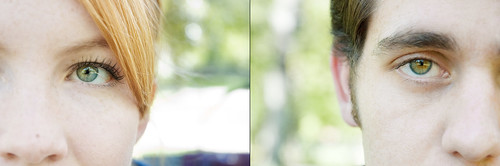
Wow. My mother recently saw this composite photo of my girlfriend April and myself. She said it was OK, but she would prefer it if I cropped out more of the space in in the center, bringing the two faces closer together. Certainly not the harshest of criticisms, but how difficult it was to hear! She's given me the same sort of casual suggestions before, and each time I have the same reaction: as she speaks I feel myself start to tense up, preparing for the blow and for my defense. I then start racking my brain, searching for some scrap of advice I had read somewhere that will justify my own take on the subject, thus proving her "wrong." She is not convinced. She then realizes I am not taking it well and not agreeing, then walks away muttering something like, "But I don't know anything about photography anyways." I am left discouraged.
This is not the proper reaction to have when being criticized. What kills me is that hers are such slight criticisms; as I continue with this effort I will certainly be critiqued harsher and more often--I better be ready with a good attitude and open ears. I think part of the problem with my reaction is that the critique is coming from someone so close to me; perhaps a stranger's words will not sting quite so much. But I think another, larger, part is my own poor response--no excuses. I am not used to being criticized at school or work, and my photography hasn't been seen by enough eyes to be seriously criticized either. So I am still learning how to cope with it and respond more positively. So please, anyone out there reading, criticize my photos! I need all the help I can get.
On a more positive note, tonight April told me a wonderful thing. She said that, since I've started pursuing photography, she's been exposed to the more artistic side of photographs, instead of the purely documentary images that fill every family's photo albums. This, in turn, has forced her to see her own world in a new way, arranging the figures in her landscape into some more aesthetic organization. This, of course, is exactly what photography asks us to do. I believe this was for her, as it was for me, an introduction to visual literacy, something most people our age are hopelessly deficient in. It's exciting that my interests, even if not my photographs, are having an impact on someone else, and that perhaps she and I could explore this subject of visual literacy together.
Subscribe to:
Posts (Atom)